/cloud-blob-2.webp)
/feather-2.png)
Important: This article is general guidance, not medical advice. If you have chronic, severe or radiating back pain — especially with numbness, weakness or symptoms below the knee — see a qualified physician or spine specialist before changing your mattress.
What spine specialists agree on
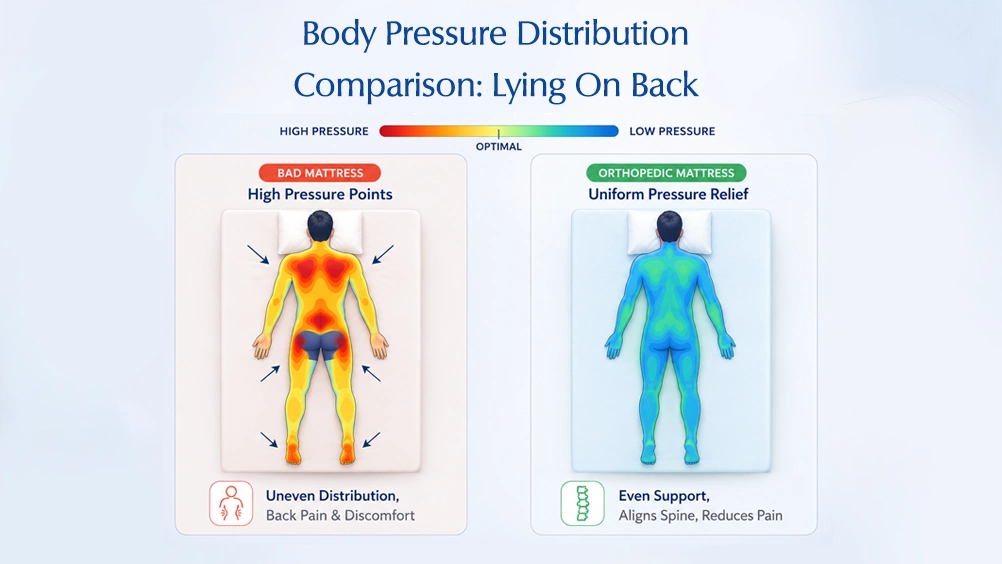
Across orthopaedic and physiotherapy literature, three things consistently come up as mattress traits that reduce mechanical lower-back pain:
- Neutral spinal alignment while you sleep — the natural S-curve of the spine should be supported, not flattened or exaggerated.
- Pressure-point relief at the shoulder and hip — so blood flow is not cut off and you do not toss to relieve numbness all night.
- Adequate firmness for body weight — too soft and the hips sink, twisting the spine; too firm and the curve in the lower back loses contact with the surface, throwing the pelvis out of line.
That third point is the one buyers get wrong most often. "Orthopaedic" in marketing usually means "very firm." For a lighter sleeper or a side sleeper, very firm is exactly the wrong answer.
Why the wrong firmness makes back pain worse
Imagine your spine viewed from the side. There is a small natural curve at the lower back. When you lie on your back, that curve creates a shallow gap between the lumbar region and the mattress surface.
- If the mattress is too soft, your hips and pelvis sink deeper than your shoulders, exaggerating the curve. Muscles around the lower back work overnight to compensate — and you wake stiff.
- If the mattress is too firm, the lower-back curve floats above the surface with no support. Spinal muscles strain to hold the shape unaided. Same result: stiffness in the morning.
- If the mattress is matched correctly, the surface fills the curve, supports the pelvis, and lets the muscles relax for 7–8 hours. That is when actual repair happens.
The "right firmness" by sleep position and weight
This is the practical part. Treat it as a starting point, then refine in the showroom.
Side sleepers
You need the surface to give at the shoulder and hip enough that your spine stays straight. Pick medium to medium-firm — typically HR foam with a memory-foam comfort layer, or a pocket-spring mattress with a pillow top. Avoid pure bonded foam.
Back sleepers
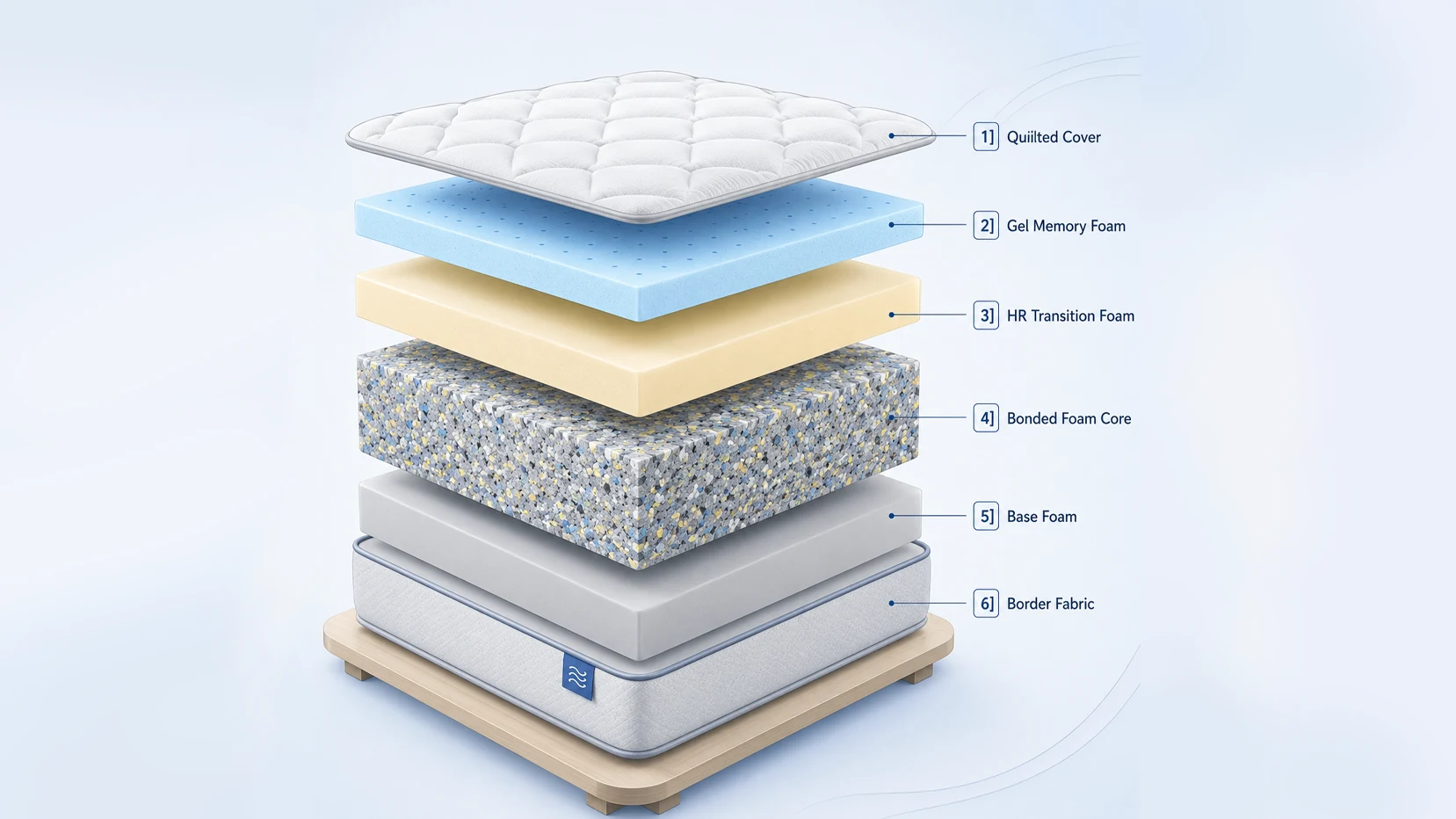
You need the surface to fill the lumbar curve while keeping the pelvis from sinking. Pick medium-firm to firm — HR foam over a bonded core is the everyday answer. A pure memory foam mattress can also work if the density is high enough (≥50 kg/m³).
Stomach sleepers
You need to keep the hips from collapsing into a "U" — which is what triggers most stomach-sleeper back pain. Pick firm — bonded foam or a firm bonnel-spring mattress is best. A memory foam mattress is usually too soft for stomach sleepers.
Body-weight adjustment
For sleepers over 90 kg, go one step firmer than the position-based recommendation above: a 90 kg back sleeper should pick a firm rather than a medium-firm. Heavier sleepers compress any surface more deeply, so the same mattress feels softer to them than to a 60 kg sleeper.
The pillow is half the battle
Most "mattress for back pain" advice ignores the pillow, which is a mistake. Your neck is the top of your spine; if it is misaligned, the rest of the spine compensates. Side sleepers need a thicker pillow that fills the gap between the shoulder and the head; back sleepers need a medium-loft pillow with cervical support; stomach sleepers need a thin pillow or none at all. Read our pillow sizing guide for the full breakdown.
What is mostly marketing
- "7-zone support" — sounds engineered, rarely changes the felt firmness more than a single regular zone of the same density.
- "NASA-certified memory foam" — NASA does not certify mattresses. Ever.
- "Doctor-recommended" — usually a marketing programme, not clinical endorsement. Ask which doctors and check.
- "Orthopaedic" as a word with no spec — specifications matter. Density, layer composition and warranty length tell you more than the word "orthopaedic."
How to test in the showroom
Take a friend, or use the dealer's smartphone if you are alone. Lie down in your normal sleep position. Have someone photograph you from the side. Look at the photo:
- If you sleep on your back: check that the lower back is in contact with the surface but the pelvis is not sinking deeper than the chest.
- If you sleep on your side: the spine should appear horizontal — no dipping at the waist, no arching upward at the shoulder.
Ten seconds of side-on photography saves more bad mattress purchases than any sales pitch.
The non-mattress factors
If you change your mattress and the pain persists after 30 days, the mattress was likely not the primary driver. Other common culprits to investigate:
- A bed frame with widely-spaced slats causing localised sag.
- A long-standing posture issue at work — often a chair, monitor height or desk depth problem.
- Weak core musculature (sedentary lifestyle).
- A medical issue requiring evaluation — disc problems, sacroiliac dysfunction, sciatica.
A good mattress can reduce mechanical back pain. It cannot replace a doctor, a stronger core, or a chair that fits.
Find a back-friendly mattress
Contact us with your city and we'll route you to your nearest authorised Sparsh dealer for an unhurried fitting. Bring this article with you if it helps the conversation.
See Our Range