/feather-1.png)
/cloud-blob-2.webp)
/cloud-blob-1.webp)
Why mattress shopping in India is hard
Walk into any furniture showroom from Ludhiana to Gurgaon and the words come at you in a rush — orthopaedic, premium, 7-zone, hotel comfort, NASA technology, cool-gel. They sound impressive. They also tell you almost nothing useful about whether the mattress on the floor will support your back, suit your bedroom climate, or last beyond its warranty period.
This guide is written from the manufacturing side of the counter. Sparsh has been making mattresses at our factory since 2006 — long enough to see what fails, what lasts, and where buyers get steered wrong. Below is the decision tree we'd give a friend, in the order it actually matters.
Start here: what kind of sleeper are you?
Your sleeping position decides more about the right mattress than any feature list on the box.
- Side sleepers need a softer top layer that lets the shoulder and hip sink in just enough to keep the spine straight. Too firm and you wake with a dead arm or sore shoulder. Look for memory foam, soft-quilted HR foam or a plush hybrid.
- Back sleepers need a balanced surface — soft enough to fill the lower-back curve, firm enough that the hips don't sink. Medium-firm HR foam or bonded foam usually wins.
- Stomach sleepers need a firmer mattress so the hips don't collapse into a "U" shape that overarches the lower back. Bonded foam in firm grade is the right starting point.
- Combination sleepers — most of us — should pick by their dominant position, the one they fall asleep in most nights.
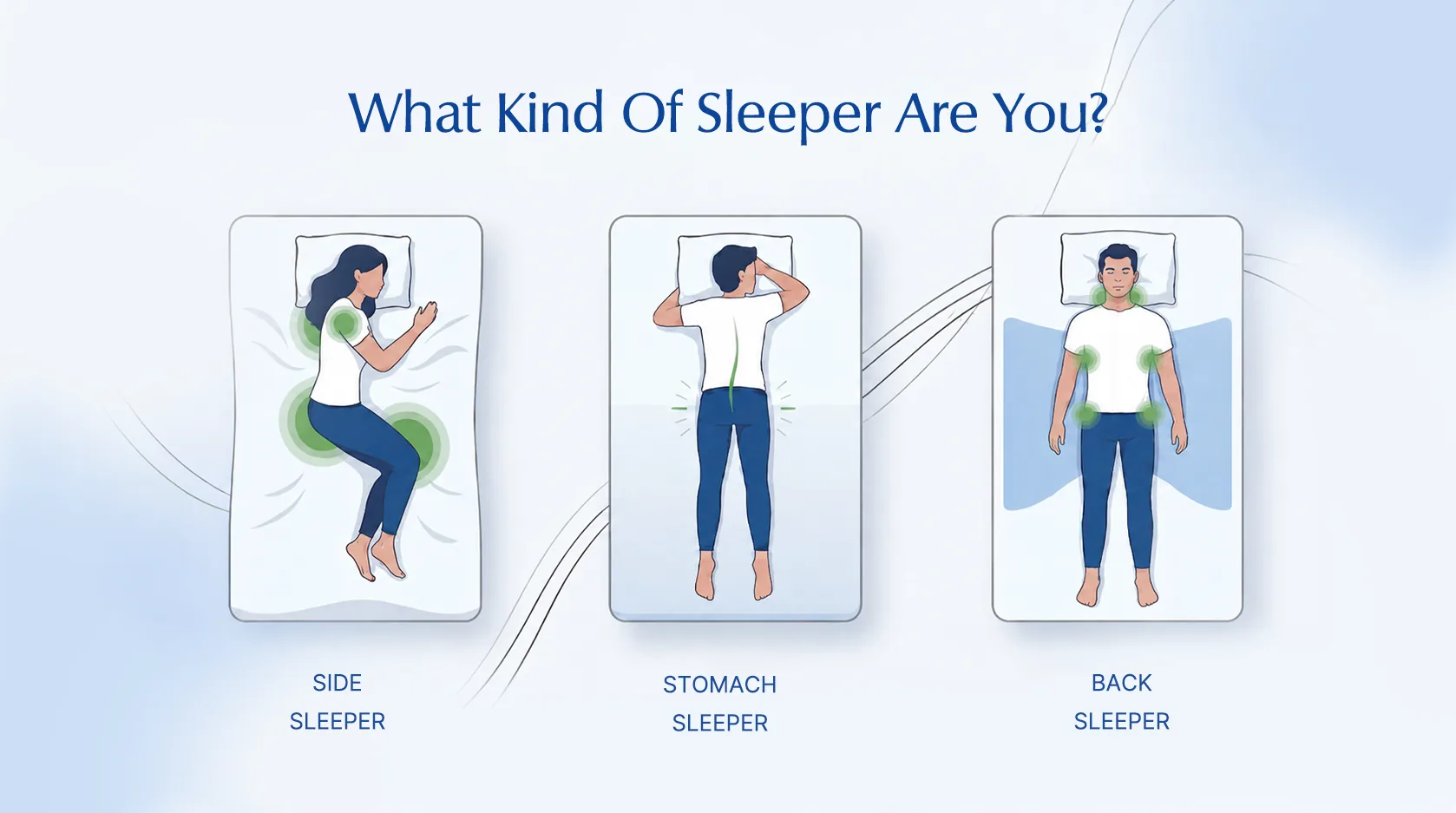
Body weight then modifies the recommendation. The same "medium-firm" mattress feels different to a 60 kg sleeper than to a 90 kg one. Heavier sleepers sink deeper into the comfort layer, so they need either a firmer surface or a thicker mattress with a denser core.
For a deeper walkthrough by sleep style, see How to Choose the Right Mattress: A Practical Guide for Indian Homes.
The four foams — and what each feels like
"Foam mattress" is a category, not a material. Inside that category sit four very different foams, each with a real personality. Sparsh manufactures with all four.
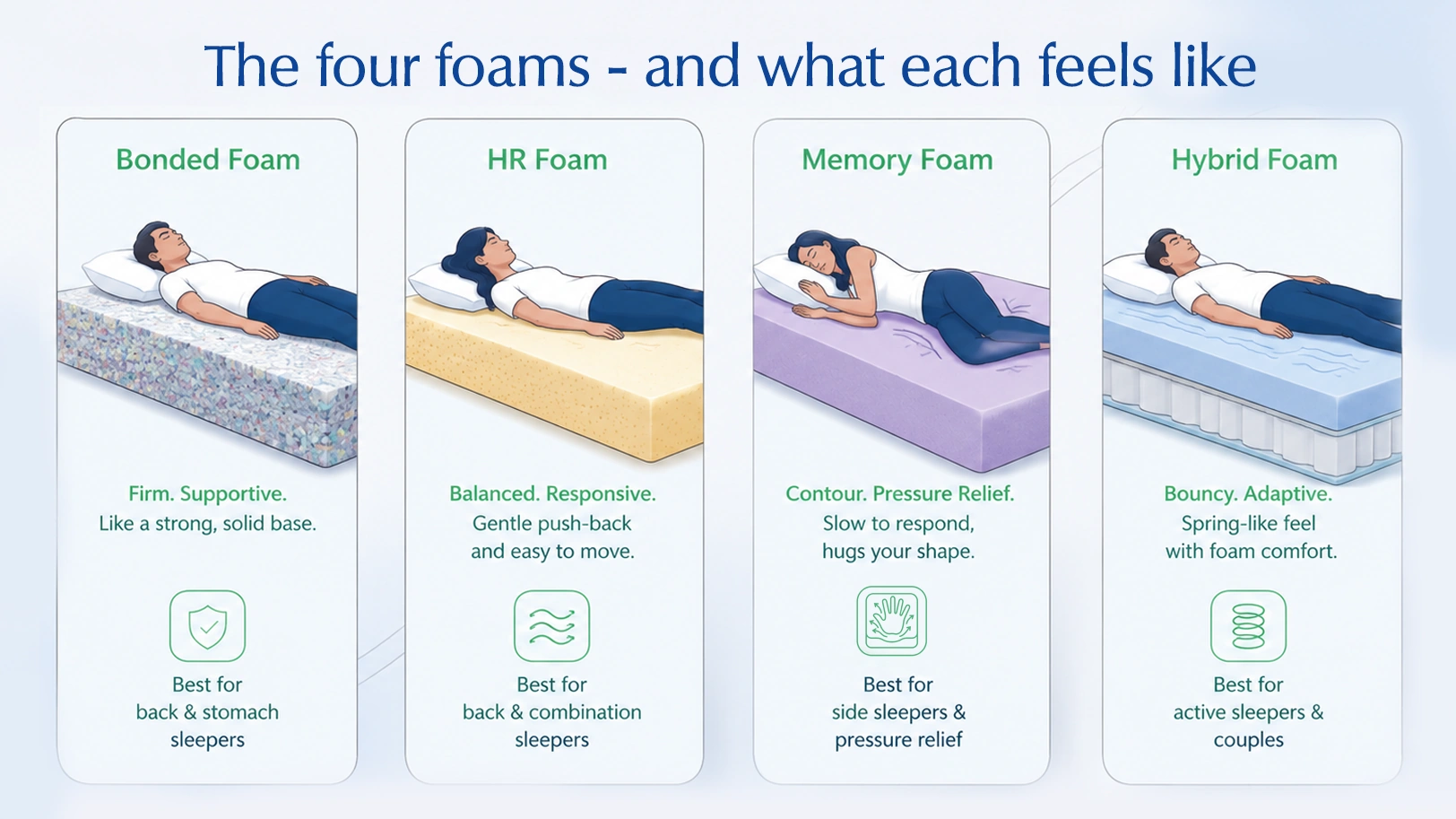
Bonded foam
Made from densified, recycled foam offcuts pressed and bonded together. Firm, durable, value-for-money — it has the longest life of any foam type when made well. Ideal for back and stomach sleepers, and for anyone who has been told to sleep on a "harder" surface. The Sparsh Alto Bond Ex, Alto Bond and Relaxi Bond are all bonded foam at different price points.
HR (high-resilience) foam
The everyday sweet spot for most Indian buyers. HR foam is more responsive than bonded foam — it pushes back gently when you press in — and it sleeps cooler than memory foam. Medium-firm grades suit back sleepers and combination sleepers. Reset and Plush sit in this band.
Memory foam
Viscoelastic foam that "remembers" your shape. It contours to pressure points — shoulders, hips, lower back — which makes it excellent for side sleepers, couples with very different weights, and anyone with stiff joints. Lower-grade memory foam can sleep warm; modern formulations (open-cell, gel-infused) solve most of that. Sparsh memory-foam models include Honey Lap, Fluid and Fluid, with Luxurious at the luxury end.
Hybrid
A responsive foam comfort layer over a firmer support core. The bounce of a spring-style feel without the noise or motion transfer. Best for active sleepers, couples and anyone who finds plain memory foam too "stuck-in." PingPong and PingPong Star are Sparsh's hybrid line.
For a side-by-side feel comparison, read Memory Foam vs HR Foam vs Bonded Foam.
The numbers that actually matter
Three numbers cut through the jargon. Ask for them by name; if a salesperson can't tell you, that's a signal in itself.
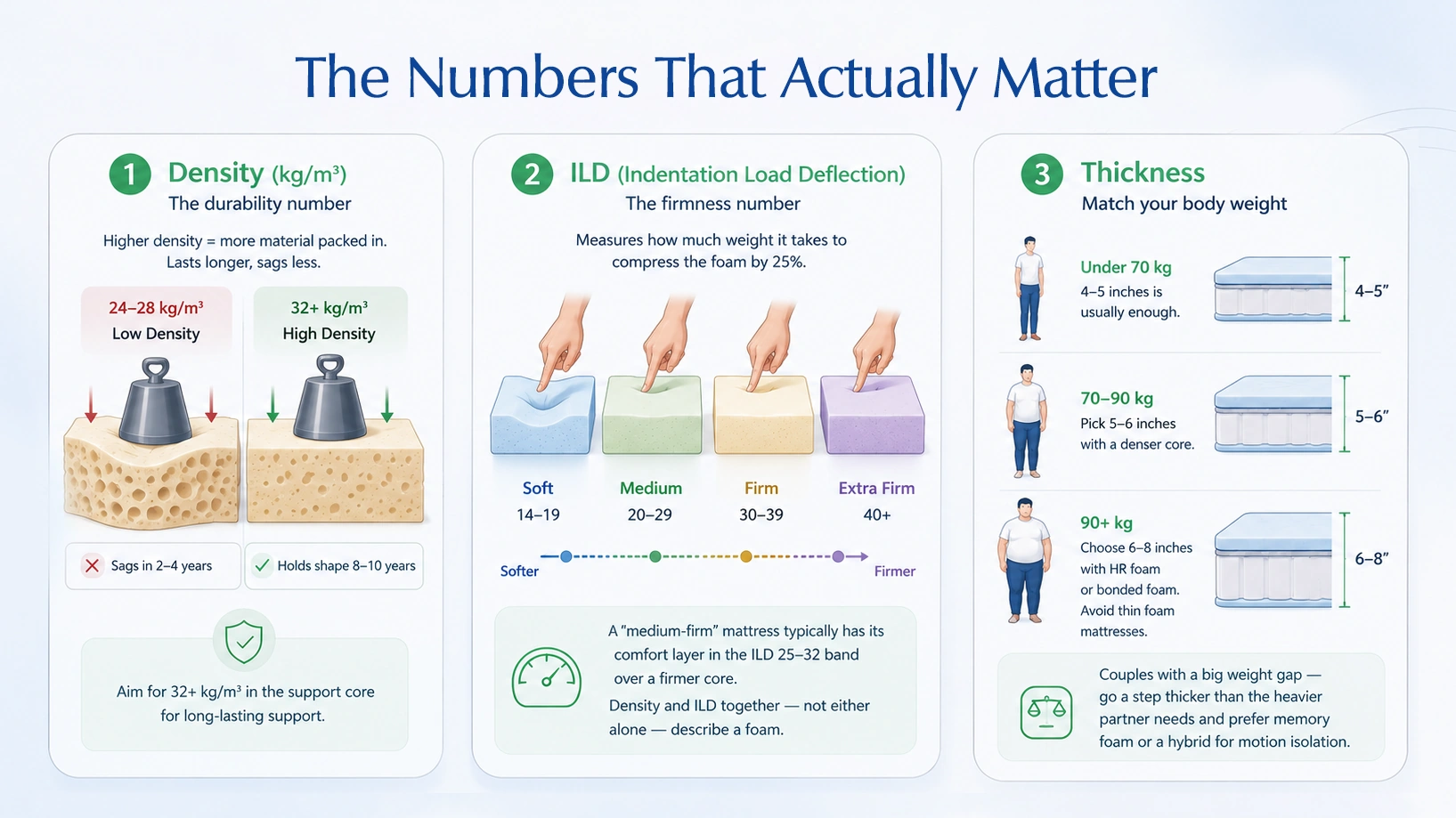
Density (kg/m³) — the durability number
Density is the weight of foam per cubic metre. It is the single best predictor of how long a foam mattress will last. A high-density foam packs more material into the same volume, so it compresses less and recovers faster.
For Indian conditions, aim for 32 kg/m³ or higher in the support core. Many cheaper mattresses use 24–28 kg/m³, which feels acceptable in the showroom but sags within 2–3 years. Density does not tell you about firmness — that's the next number.
ILD — the firmness number
ILD (Indentation Load Deflection) measures how much weight it takes to compress the foam by 25%. Higher ILD = firmer.
- ILD 14–19 — soft
- ILD 20–29 — medium
- ILD 30–39 — firm
- ILD 40+ — extra firm
A "medium-firm" mattress typically has its comfort layer in the ILD 25–32 band over a firmer core. Density and ILD together — not either alone — describe a foam.
Thickness — by body weight
- Under 70 kg — 4–5 inches is usually enough.
- 70–90 kg — pick 5–6 inches with a denser core.
- Over 90 kg — choose 6–8 inches with HR foam or bonded foam. Avoid thin foam mattresses; they bottom out under heavier load.
- Couples with a big weight gap — go a step thicker than the heavier partner needs and prefer memory foam or a hybrid for motion isolation.
For more on Indian sizes and thickness conventions, see Mattress Sizes in India: A Practical Guide.
Diagnose by problem
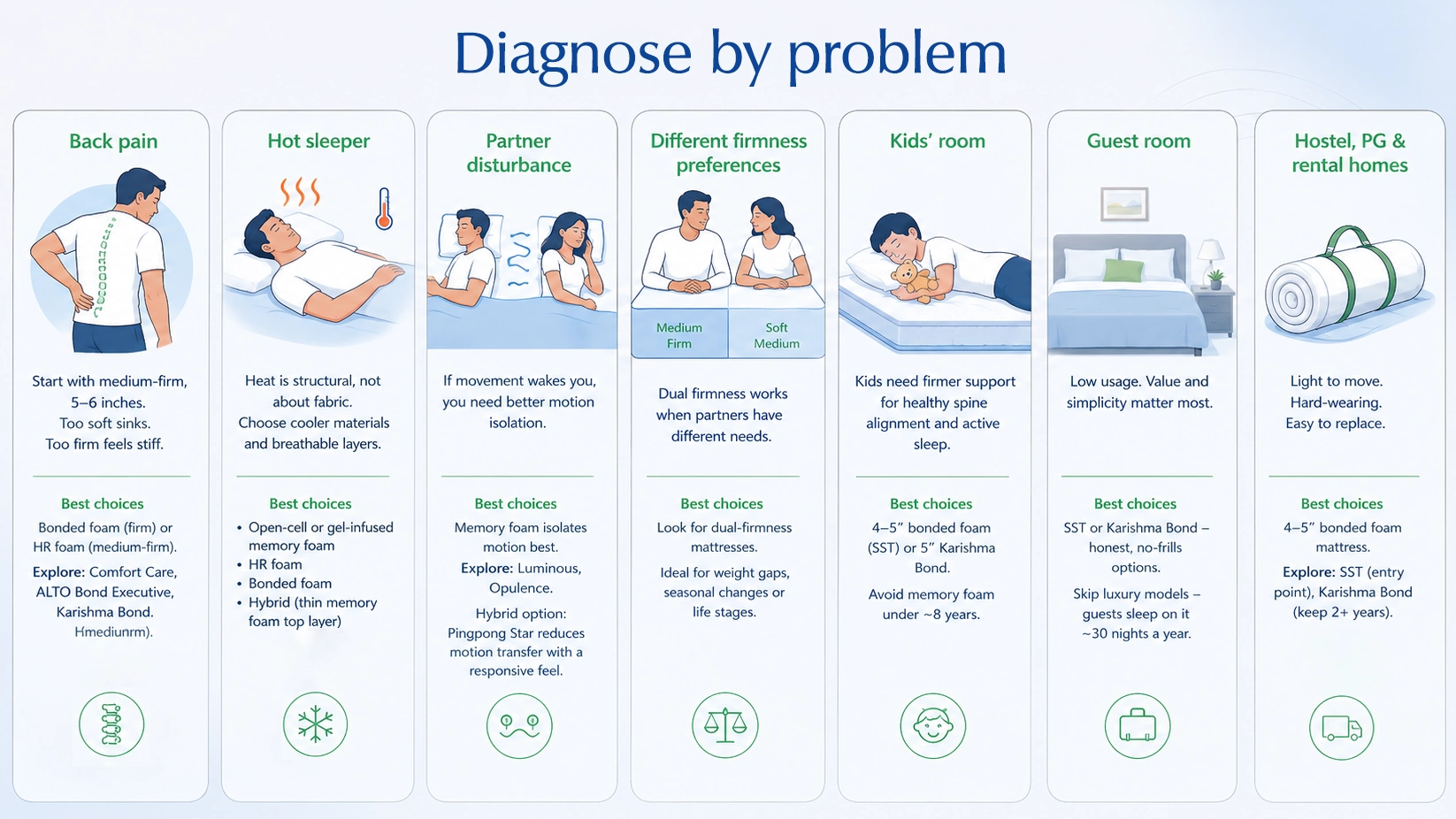
Back pain
Most spine specialists recommend medium-firm. Too soft and the hips sink, opening the lumbar curve. Too firm and the curve is unsupported and you wake stiff. Start with bonded foam in firm or HR foam in medium-firm at 5–6 inches. Reset, Alto Bond Ex and Alto Bond are built for this profile. For side sleepers with shoulder or hip pain, switch to a memory-foam model like Honey Lap or Fluid so the pressure points relieve themselves.
For a focused walk-through of mattress choices for chronic lower-back pain, see The Right Mattress for Lower Back Pain.
Hot sleeper
Heat is a structural problem, not a fabric problem. Solid memory foam traps body heat. Solutions, in order of effectiveness: open-cell or gel-infused memory foam (used in our Real Puff series), HR foam (naturally cooler than memory foam), bonded foam (most breathable of the three), and a hybrid construction so the memory foam is a thin top layer rather than the whole mattress. Pair with a breathable cotton or bamboo mattress protector. More tactical advice in Sleeping Cool Through Indian Summers.
Partner disturbance
If your partner's movement wakes you, the issue is motion transfer. Memory foam isolates motion best — Fluid and Luxurious are good choices. PingPong Star, our hybrid, also reduces motion transfer compared to plain bonded foam while keeping a responsive feel.
Different firmness preferences in a couple
Some mattresses offer dual firmness — useful when one partner is heavier than the other, or when preferences shift with seasons or pregnancy.
Kids' room
Kids need a firmer surface than adults — their lower body weight doesn't compress soft foams enough for spinal alignment, and they tend to be active sleepers who benefit from a non-sinking feel. A 4–5 inch bonded foam mattress like Plush or a 5 inch Alto Bond is usually right. Avoid memory foam under the age of about 8 — it can be too contouring for small frames.
Guest room
Use-frequency low, durability low-priority, value top-priority. Plush and Alto Bond are honest, no-frills options. Skip the luxury models — guests sleep on it 30 nights a year.
Hostel, PG and rental homes
You want something light enough to move, hard-wearing, and replaceable without heartbreak. A 4–5 inch bonded foam mattress fits all three boxes. Plush is the entry point in the Sparsh range; Alto Bond if you'll keep it more than two years. Roll-pack delivery (where available from your dealer) makes them easier to carry up to a third-floor flat.
For a budget-first walk-through, see Mattress Budget Guide India: What You Get at Each Price Point.
Sparsh recommendations by budget tier
Authorised dealer pricing varies by city and size, so we list models by tier rather than printed prices. Contact us with your city and we'll route you to your nearest authorised Sparsh dealer for live pricing on the size you need.
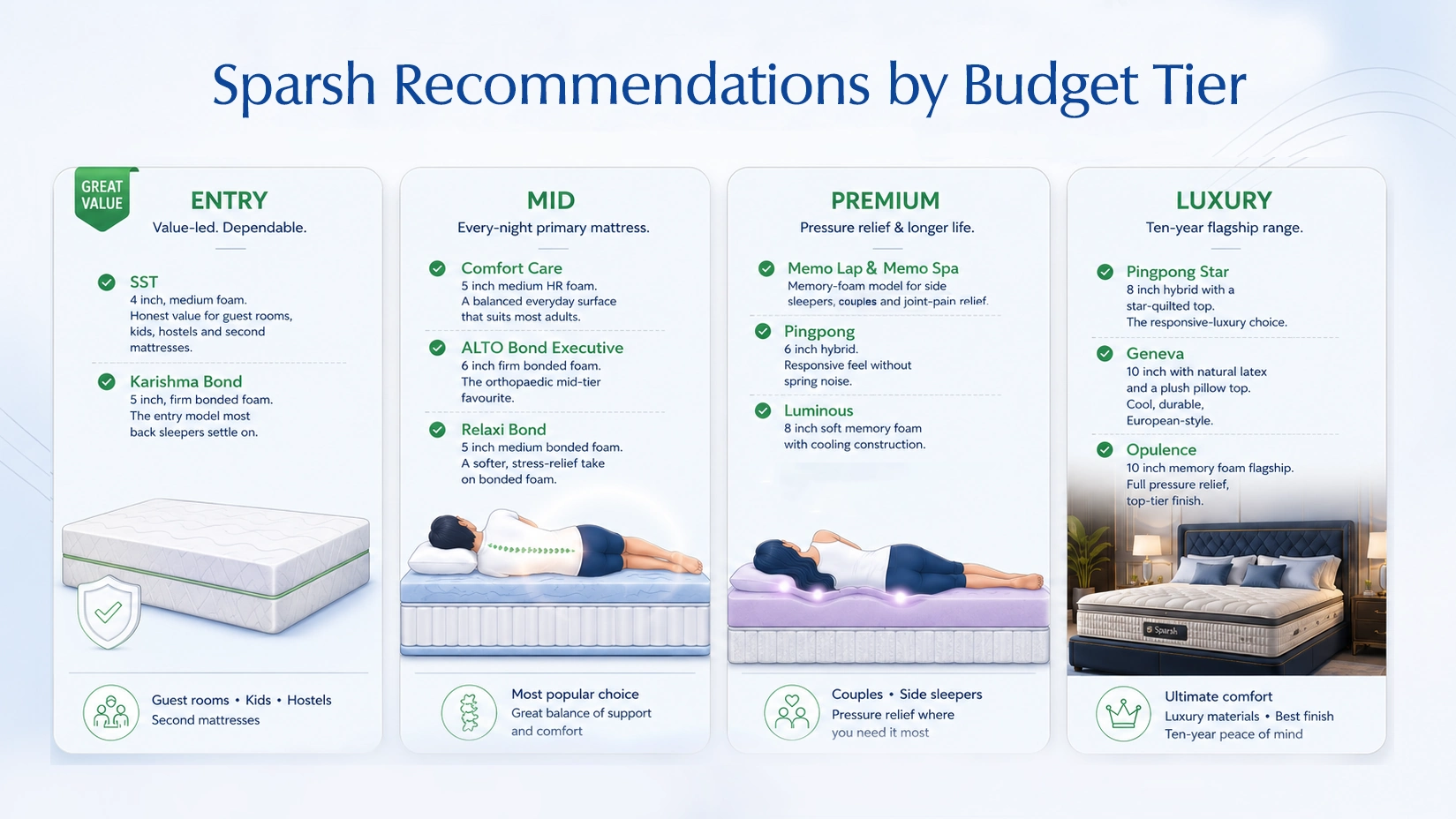
Value-led, dependable
- Plush — 4 inch, medium foam. Honest value for guest rooms, kids, hostels and second mattresses.
- Alto Bond — 5 inch, firm bonded foam. The entry model most back sleepers settle on.
Every-night primary mattress
- Reset — 5 inch medium HR foam. A balanced everyday surface that suits most adults.
- Alto Bond Ex — 6 inch firm bonded foam. The orthopaedic mid-tier favourite.
- Relaxi Bond — 5 inch medium bonded foam. A softer, stress-relief take on bonded foam.
Pressure-relief and longer life
- Honey Lap & Fluid — memory-foam models for side sleepers, couples and joint-pain sufferers.
- PingPong — 6 inch hybrid, responsive feel without spring noise.
- Fluid — 8 inch soft memory foam with cooling construction.
Ten-year flagship
- PingPong Star — 8 inch hybrid with a star-quilted top. The responsive-luxury choice.
- Harmony — 10 inch with natural latex and a plush pillow top. Cool, durable, European-style.
- Luxurious — 10 inch memory foam flagship. Full pressure relief, top-tier finish.
For a fuller walk-through across budgets, see Mattress Budget Guide India.
What ₹10k, ₹20k and ₹40k Actually Get You?
Once you know your sleeper type and support needs, the next question is where the budget should go. Mattress pricing is not only about thickness or a bigger warranty number. A better mattress usually earns its price through denser support foam, smarter layering, stronger quilting, better temperature control and a finish that holds shape after years of use.
The trap is assuming every jump in price buys the same kind of upgrade. It does not. The move from ₹10k to ₹20k is often about daily-use durability. The move from ₹20k to ₹40k is more about pressure relief, refinement and premium feel. Buy the tier that matches your real use, not the tier that sounds impressive in a showroom.
Around ₹10k: practical support, limited luxury
This tier is for value-first use: guest rooms, kids' rooms, hostels, rental flats, second mattresses and buyers who prefer a firmer surface without added plushness. You should expect simple construction, fewer comfort layers and a more basic fabric finish. That is not automatically bad. A straightforward bonded foam or medium foam mattress can still be the right buy if the use case is light or the sleeper likes a firm feel.
- What to prioritise: firmness match, usable thickness and a support core that does not feel hollow or overly springy.
- What not to expect: deep pressure relief, advanced cooling, luxury quilting or a plush hotel-like surface.
- Best fit: children, guest beds, PGs, rentals and budget-conscious back or stomach sleepers.
Around ₹20k: the everyday sweet spot
For many Indian homes, this is where the sensible primary mattress lives. You start getting better balance: denser support, more consistent comfort, better thickness options and construction that is meant for nightly adult use. If you sleep on the mattress every day and want it to last, this is usually the first tier worth stretching into.
- What improves: core quality, comfort stability, long-term shape retention and suitability for adult body weight.
- What to check: whether the mattress is firm, medium-firm or softer at the surface; the same price can suit very different sleepers.
- Best fit: most couples, working adults, back sleepers and buyers replacing an old sagging mattress.
Around ₹40k: comfort refinement and premium build
At this level, the upgrade should feel specific. You are paying for pressure relief, layered comfort, cooler sleep, better motion isolation, a more responsive hybrid feel, premium quilting or a flagship finish. This tier makes the most sense for side sleepers, couples with movement disturbance, heavier sleepers who need thicker construction, or anyone who treats the bed as a long-term comfort purchase.
- What should be visible: better top-layer comfort, higher-end fabric, cleaner finishing and a mattress that feels supportive without feeling hard.
- What to avoid: paying only for branding, inflated warranty language or a thick mattress with weak inner construction.
- Best fit: side sleepers, premium master bedrooms, couples, pressure-point issues and buyers planning for 8–10 years of daily use.
Read the full budget-first article here: Mattress Budget Guide: What ₹10k, ₹20k and ₹40k Actually Get You.
The right pillow for your mattress
A mattress decides spinal alignment from the shoulders down. The pillow decides it for the cervical spine — and the wrong pillow can undo a great mattress.
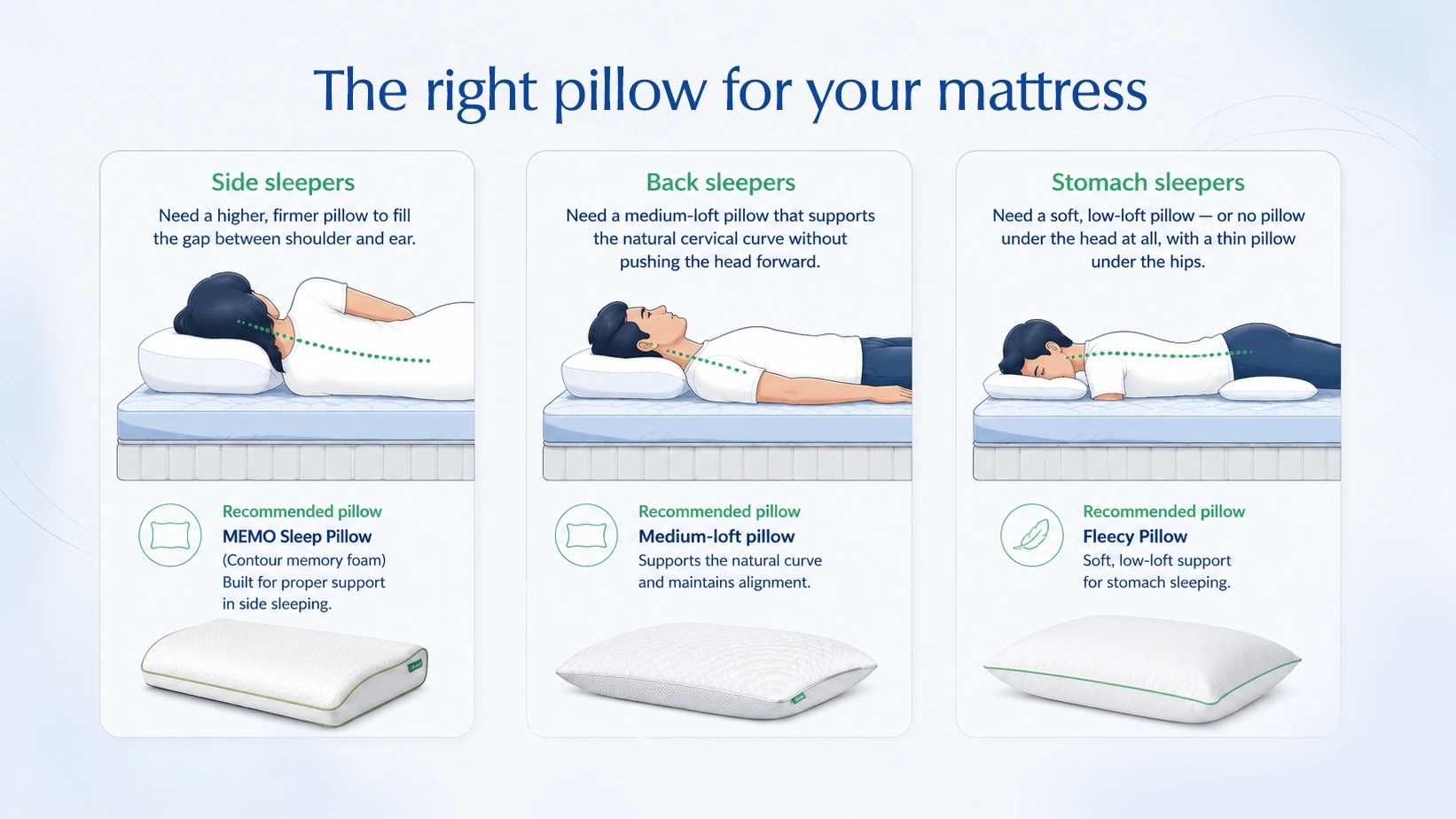
- Side sleepers need a higher, firmer pillow to fill the gap between shoulder and ear. The MEMO Sleep Pillow (contour memory foam) is built for this.
- Back sleepers need a medium-loft pillow that supports the natural cervical curve without pushing the head forward.
- Stomach sleepers need a soft, low-loft pillow — or no pillow under the head at all, with a thin pillow under the hips. The Fleecy Pillow works for this profile.
More on the pillow-position pairing in The Right Pillow for Your Sleep Position.
Care, warranty & lifespan
A well-made foam mattress with adequate density should give you 8–10 years of daily use. To get there:
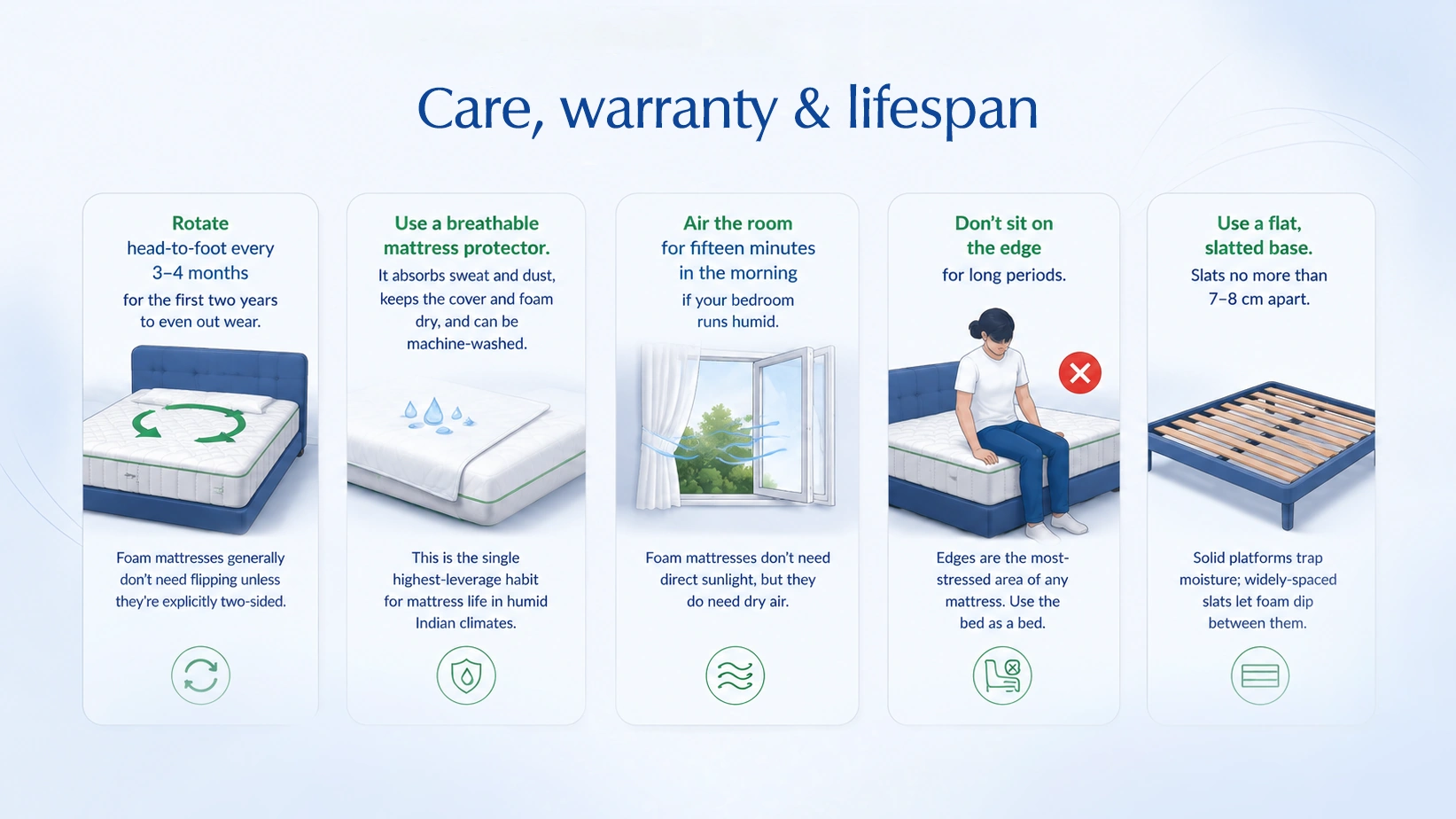
- Rotate head-to-foot every 3–4 months for the first two years to even out wear. Foam mattresses generally don't need flipping unless they're explicitly two-sided.
- Use a breathable mattress protector. It absorbs sweat and dust, keeps the cover and foam dry, and can be machine-washed. This is the single highest-leverage habit for mattress life in humid Indian climates.
- Air the room for fifteen minutes in the morning if your bedroom runs humid. Foam mattresses don't need direct sunlight, but they do need dry air.
- Don't sit on the edge for long periods. Edges are the most-stressed area of any mattress. Use the bed as a bed.
- Use a flat, slatted base. Slats no more than 7–8 cm apart. Solid platforms trap moisture; widely-spaced slats let foam dip between them.
Sparsh warranty terms vary by model and are honoured through the dealer who delivered the mattress. Keep the warranty card and original invoice. Full care detail: Mattress Care Tips: How to Make It Last 10 Years. Replacement signs: When Should You Replace Your Mattress?
Five buying mistakes to avoid
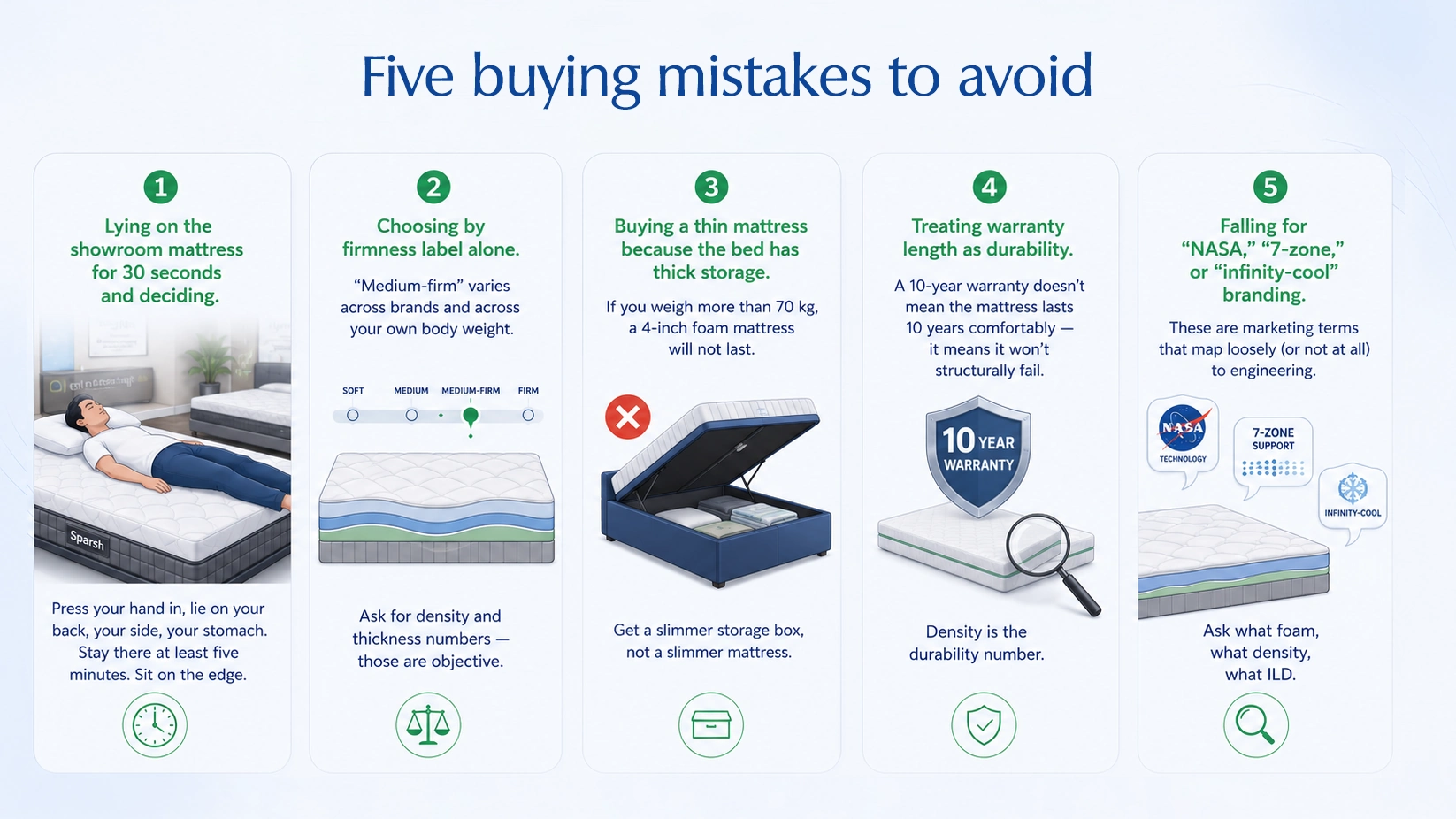
- Lying on the showroom mattress for 30 seconds and deciding. Press your hand in, lie on your back, your side, your stomach. Stay there at least five minutes. Sit on the edge.
- Choosing by firmness label alone. "Medium-firm" varies across brands and across your own body weight. Ask for density and thickness numbers — those are objective.
- Buying a thin mattress because the bed has thick storage. If you weigh more than 70 kg, a 4-inch foam mattress will not last. Get a slimmer storage box, not a slimmer mattress.
- Treating warranty length as durability. A 10-year warranty doesn't mean the mattress lasts 10 years comfortably — it means it won't structurally fail. Density is the durability number.
- Falling for "NASA," "7-zone," or "infinity-cool" branding. These are marketing terms that map loosely (or not at all) to engineering. Ask what foam, what density, what ILD.
Frequently asked questions
What is the best mattress thickness for an adult in India?
For adults under 70 kg, 4–5 inches is usually sufficient. Between 70–90 kg, choose 5–6 inches with a denser core. Above 90 kg, pick 6–8 inches with HR or bonded foam — thinner mattresses bottom out and lose support.
What is foam density and why does it matter?
Density is the weight of foam per cubic metre (kg/m³). It is the single best predictor of how long a foam mattress will last. For Indian conditions, look for 32 kg/m³ or higher in the support core. Lower-density foams compress and sag within a few years, even if they feel firm in the showroom.
Is memory foam too hot for Indian summers?
Older closed-cell memory foams can sleep warm. Modern memory foams — including the variants used in Sparsh's Real Puff series — use open-cell structures and gel infusions that draw heat away. A breathable cover and a 6–8 inch construction (so memory foam is the comfort layer over a cooler HR or bonded core) usually solves the heat problem.
How do I choose a mattress for back pain?
Most spine specialists recommend medium-firm. Bonded foam or a firm HR foam in 5–6 inch thickness usually works for back-pain sleepers. Sparsh models like Reset, Alto Bond Ex and Alto Bond are built for this profile. Side sleepers with shoulder or hip pain should switch to a memory-foam model.
How long should a good mattress last?
A well-made foam mattress with adequate density should last 8–10 years of daily use. Bonded and HR foam tend to last the longest. Memory-foam comfort layers usually outlast the warranty when paired with a quality core. Rotate head-to-foot every 3–4 months and use a breathable mattress protector to maximise lifespan.
What's the difference between density and ILD?
Density measures durability — how much foam material is in a cubic metre. ILD measures firmness — the force needed to compress the foam by 25%. A high-density foam can be either soft or firm; a high-ILD foam is firm but not necessarily durable. Density is the more important number for Indian buyers.
Where can I buy a Sparsh mattress?
Sparsh is sold through authorised dealers across Punjab, Haryana and Delhi NCR. Browse the full range on the Products page and reach us via Support for the closest dealer to you.