/cloud-blob-1.webp)
/feather-1.png)
We see returned mattresses every month at our facility in Khanna. Most of the ones with sagging, staining or premature wear failed not because of manufacturing defects but because of small habits that stacked up over the years. Here is what we have learned from the factory floor.
1. Rotate every three months in year one

For the first 12 months, rotate the mattress 180 degrees (head-to-foot) every three months. This evens out body impressions while the foam is settling into its final form. After year one, twice a year is enough.
Note: most modern mattresses (including all Sparsh models) are one-sided — they have a single intended sleep surface. Do not flip them top-to-bottom; you will wear out the comfort layers in half the time.
2. Use a breathable mattress protector from day one
A waterproof, breathable mattress protector is the cheapest insurance you will ever buy. It blocks stains, sweat and dust mites without trapping heat. It also keeps the warranty intact — most mattress warranties (including Sparsh's) are voided by visible staining, because stains usually indicate moisture damage to the foam below.
Skip vinyl protectors. They block moisture but trap heat — you will sweat more and shorten the comfort layer's life. Look for a cotton-faced, polyurethane-membrane protector. Around ₹600–₹1,500 buys a good one. Wash it once a month.
3. Vacuum every 4 to 6 weeks
Use the upholstery attachment on a household vacuum to lift dust and skin cells off the surface. This is especially important in summer when humidity gives dust mites a head-start. Pay attention to the seams along the perimeter; that is where lint collects.
Avoid steam cleaners and any wet methods on the mattress itself. Foam is hygroscopic — once it gets deeply wet, it can take weeks to dry and may grow mould inside the layers where you cannot see.
4. Spot-clean stains immediately
Blot — never rub. A dry cloth first, then cold water mixed with a tiny amount of mild detergent on a damp cloth. Dab dry and let the spot air-dry under a fan before remaking the bed.
Things to avoid:
- Bleach — discolours fabric, weakens fibres and voids warranty.
- Solvents (acetone, white spirit) — eat through bonded layers.
- Hot water — sets stains, especially on protein-based ones (blood, milk, urine).
5. Air it out once a quarter
Strip the bed completely four times a year and let the mattress breathe under a ceiling fan or near an open window for 4–6 hours. This dries out the small amount of moisture every sleeper releases — roughly 200 ml per night — and refreshes the foam. Direct strong sunlight is fine in moderation but will fade the fabric over months, so pick indirect light if you can.
6. The four habits that kill mattresses
From the warranty-claim files:
- Folding the mattress for transport. Even once. Bonded layers crack along the fold line and never recover. If you are moving, ask the dealer for a flat-roll service.
- Putting the mattress directly on a thin cot or box without a flat ply top. Slats spaced more than 7 cm apart let the mattress sag through the gaps. Boxes without a solid ply top do the same.
- Sitting on the same edge every night for hours (laptop in bed, edge of the mattress as a couch). The perimeter compresses unevenly and the centre starts to feel taller within a year.
- Letting kids and pets jump on the bed. Repeated impact at concentrated points is the fastest way to break inner layers. The Sparsh range is engineered for sleep loads, not trampolining.
7. Check the bed frame yearly
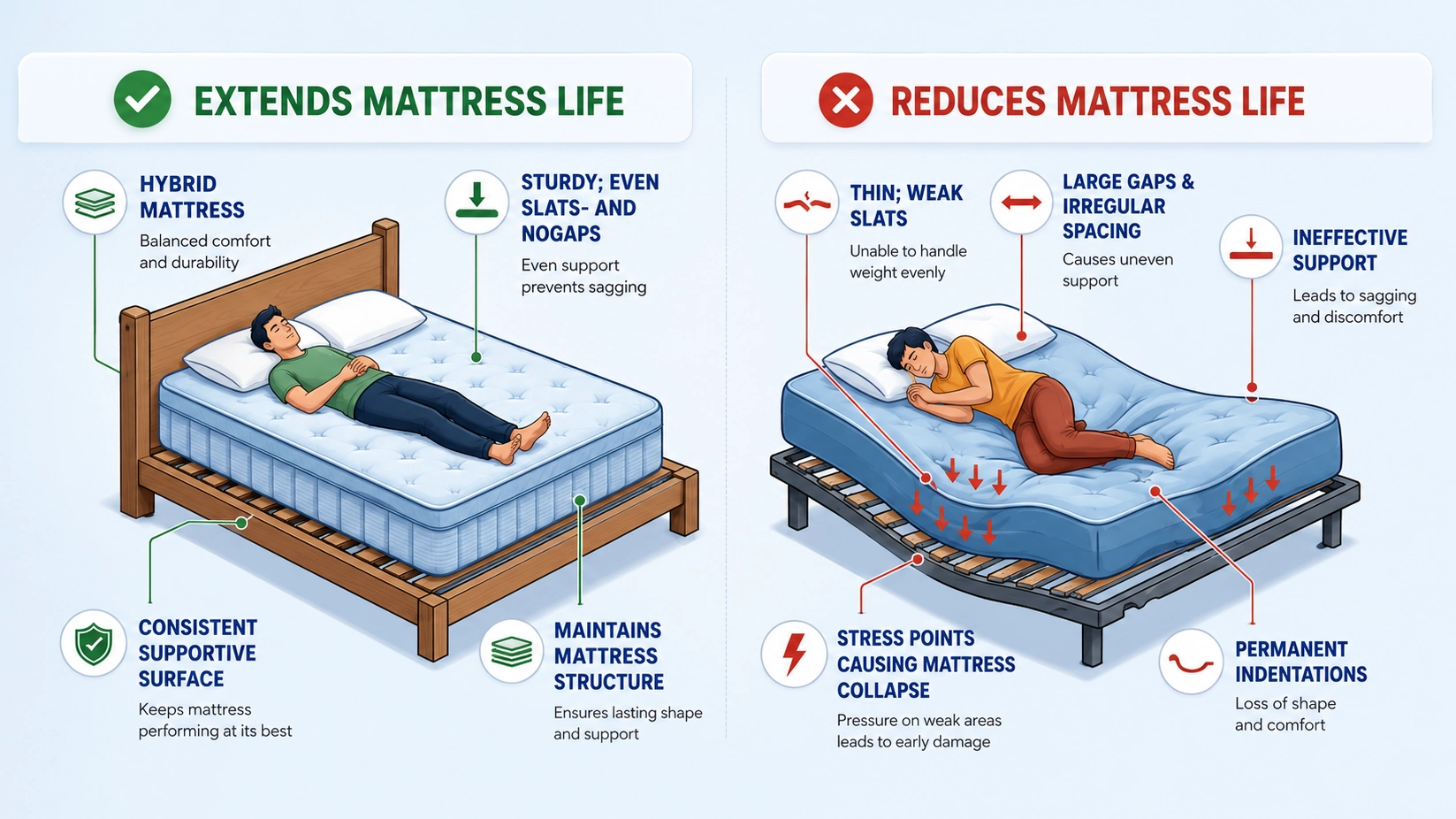
The mattress's lifespan is half about the mattress and half about what is under it. Once a year, strip the bed and check that:
- All slats are intact and evenly spaced (no gaps over 7 cm).
- The frame's centre support, if any, is screwed in tight.
- If you have a storage box, the ply top is not bowing.
A sagging frame will sag a mattress no matter how good the mattress is. Catch it early.
8. Storage tips, if you must
If you need to store a mattress (moving, renovating), keep it flat in a dry, cool room. Wrap it in a breathable mattress bag — never plastic for long-term storage, which traps moisture. Do not stack heavy things on top. A mattress can survive a few months of storage in good shape if you do this; six months in a damp garage is usually fatal.
The single best predictor of how long a mattress lasts is whether it has a protector on it from night one. Everything else is bonus.
Need a fresh start?
Sparsh mattresses are built with high-density cores designed for a decade or more of household use. Find your local dealer to see the range.
See Mattresses