/cloud-blob-3.webp)
/feather-3.png)
"Foam mattress" is the most over-used phrase in Indian retail. It can mean four very different materials, each with its own personality. The three you will encounter most often are bonded foam, HR (high-resilience) foam, and memory foam. Get the difference right and you will spend exactly the budget you should — no more, no less.
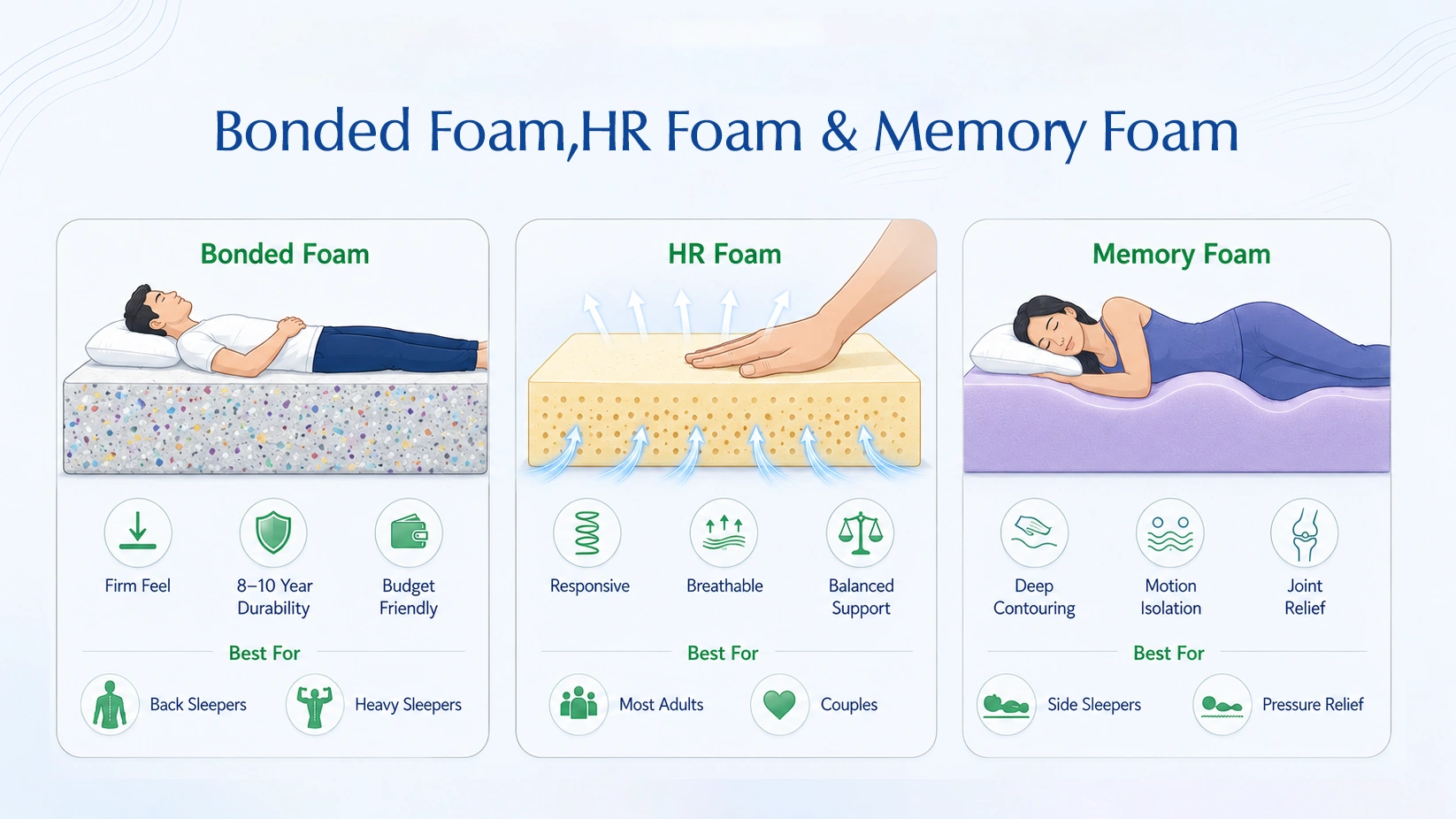
Bonded foam — the reliable workhorse
Bonded foam is made by densifying off-cuts and recycled foam pieces under heat and pressure into a solid, uniform block. The result is firm, very durable, and the most cost-effective core layer in any mattress.
Feel: Firm. There is little contouring. You sleep "on" the surface, not "in" it.
Durability: Excellent. Bonded foam holds shape for 8–10 years under normal household use without sagging. It is a great answer to "I want a mattress that will not let me down in five years."
Best for: Back sleepers, heavier sleepers (over 90 kg), buyers who like a firm surface, kids' rooms, and budget-conscious primary beds.
Trade-off: Side sleepers will feel pressure points at the shoulder and hip after 30–40 minutes. Couples with weight differences will feel motion transfer.
HR (High-Resilience) foam — the everyday sweet spot
HR foam is a fresh, open-cell polyurethane foam engineered for a high rebound rate — it springs back quickly when you move. It feels lively, supportive and breathable, which is why it dominates the middle of the Indian mattress market.
Feel: Medium-firm with bounce. Responsive without being hard.
Durability: 10+ years with care. The open-cell structure also breathes well, so heat does not get trapped the way it does in lower-grade foams.
Best for: Most adult primary beds. Couples. Combination sleepers. Anyone who does not have a strong preference and wants a balanced everyday surface.
Trade-off: Will not contour as deeply as memory foam, so it does not isolate pressure points quite as well for side sleepers with stiff joints. Premium memory foam wins on that exact dimension.
Memory foam — the contouring specialist
Memory foam is viscoelastic — it softens with body heat, conforms to your shape, and "remembers" where you were a moment after you move. It was originally engineered by NASA in the 1960s for aircraft seating. It is the only foam that genuinely cradles the body's curves.
Feel: Cushiony, slow-rebound, deep contouring. You sleep slightly "in" the surface. The first night feels different — most sleepers love it within a week.
Durability: 8–10 years. Quality varies enormously between cheap and premium memory foams; the better grades have higher density and resist body impressions.
Best for: Side sleepers, light to medium sleepers, couples with very different weights (memory foam isolates motion better than any other foam), and people with stiff hips, shoulders or recurring joint pain.
Trade-off: Lower-grade memory foam can sleep hot in summer. Look for cooling-gel infusion, an open-cell structure, or a perforated layer if you live in Delhi, India or Haryana. Memory foam is also harder to roll on for combination sleepers — the slow rebound means turning over takes a fraction of a second longer than HR or spring.
The "fourth foam" — Softy/EP foam quilt
Honourable mention: most mattresses, regardless of core, use a softy or expanded-polyethylene (EP) foam quilt as their top comfort layer. It is the soft, plush feel you sense in the first few seconds of lying down. The core foam underneath is what determines the long-term performance; the softy quilt is the personality on day one.
The decision matrix
- Pick bonded foam if you want firm support, long durability and the lowest price that does not feel cheap. Sparsh's Bodycare and Surface ranges are built around this.
- Pick HR foam if you want everyday comfort that suits 80% of sleepers. Most of the Bodycare range and many premium quilts use HR layers over a bonded core. Best for couples who do not have strong shared preferences.
- Pick memory foam if you sleep on your side, share the bed with someone of very different weight, or wake with stiff joints. The Real-Puff series is built around this.
What dealers will not always tell you
The number printed on the price tag is not the most useful piece of information. Foam density (kg/m³) is. Higher density means a longer-lasting mattress that will not sag prematurely. Look for HR foam at =40 kg/m³ and memory foam at =50 kg/m³. If the dealer cannot tell you the density, that is a signal to slow down.
Density is to a foam mattress what GSM is to a bedsheet — the spec that quietly decides how long it lasts.
The hybrid option
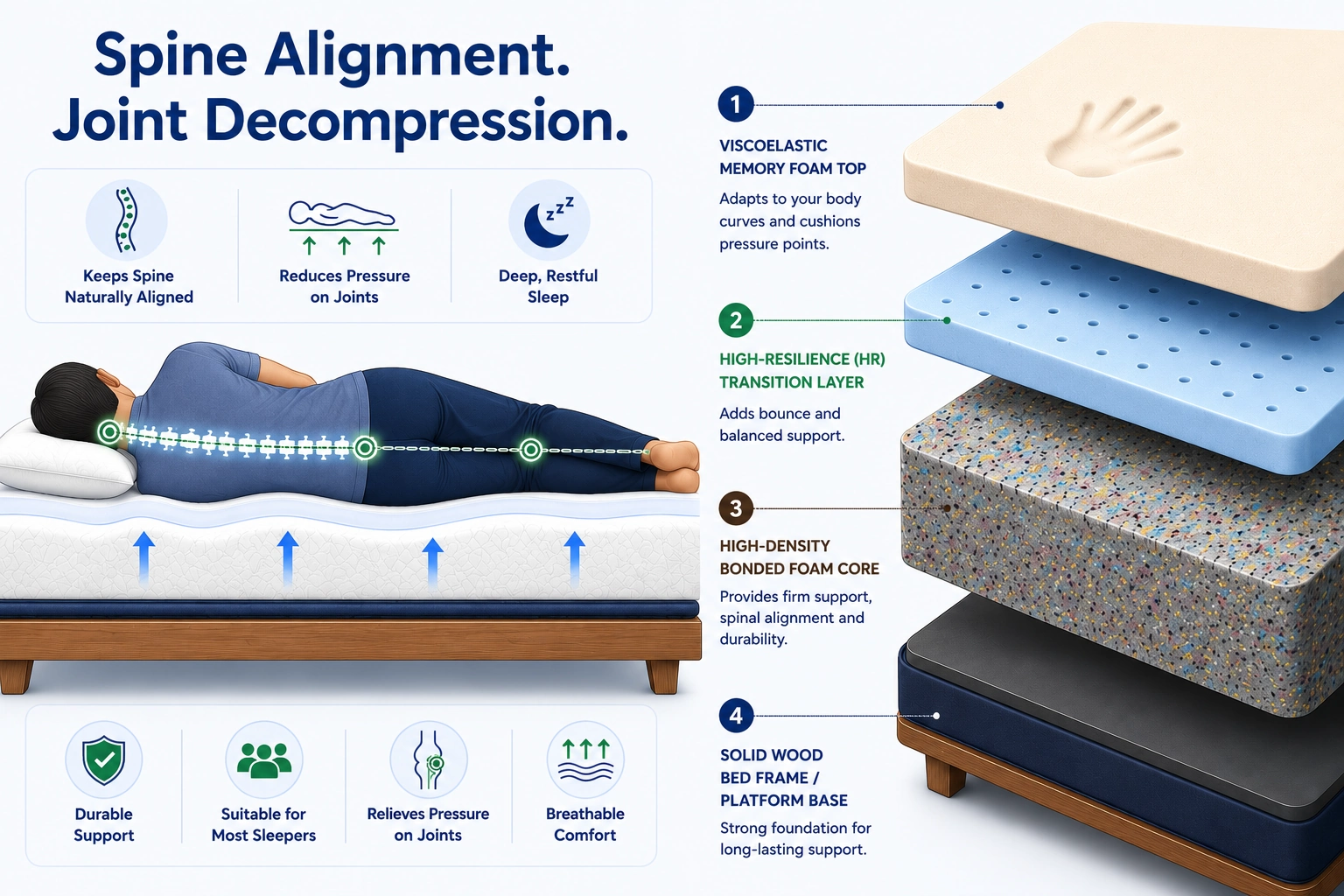
If the trade-offs feel painful, hybrids exist. A 1.5"–2" memory foam top layer on a 4"–5" HR foam core gives you contouring without the heat trap. A pocket-spring core with a memory foam pillow-top gives you bounce, breathability and contouring at once. Hybrids cost more, but for couples with very different needs, they often pay for themselves in saved arguments.
Try them in person.
Foam decisions are very hard to make from a website. Contact us with your city and we'll route you to your nearest authorised Sparsh dealer — lie down on each type for 8 minutes, and let your back tell you what to buy.
Browse the Range