/cloud-blob-1.webp)
/feather-1.png)
Your neck is the top six vertebrae of your spine — and the most flexible part. A pillow that is too tall pushes the head forward; one that is too flat lets it tilt back. Either way, the muscles around the neck spend the night holding the head in an unnatural angle. That is the soreness you feel at 7 a.m.
Pillow loft, by sleep position
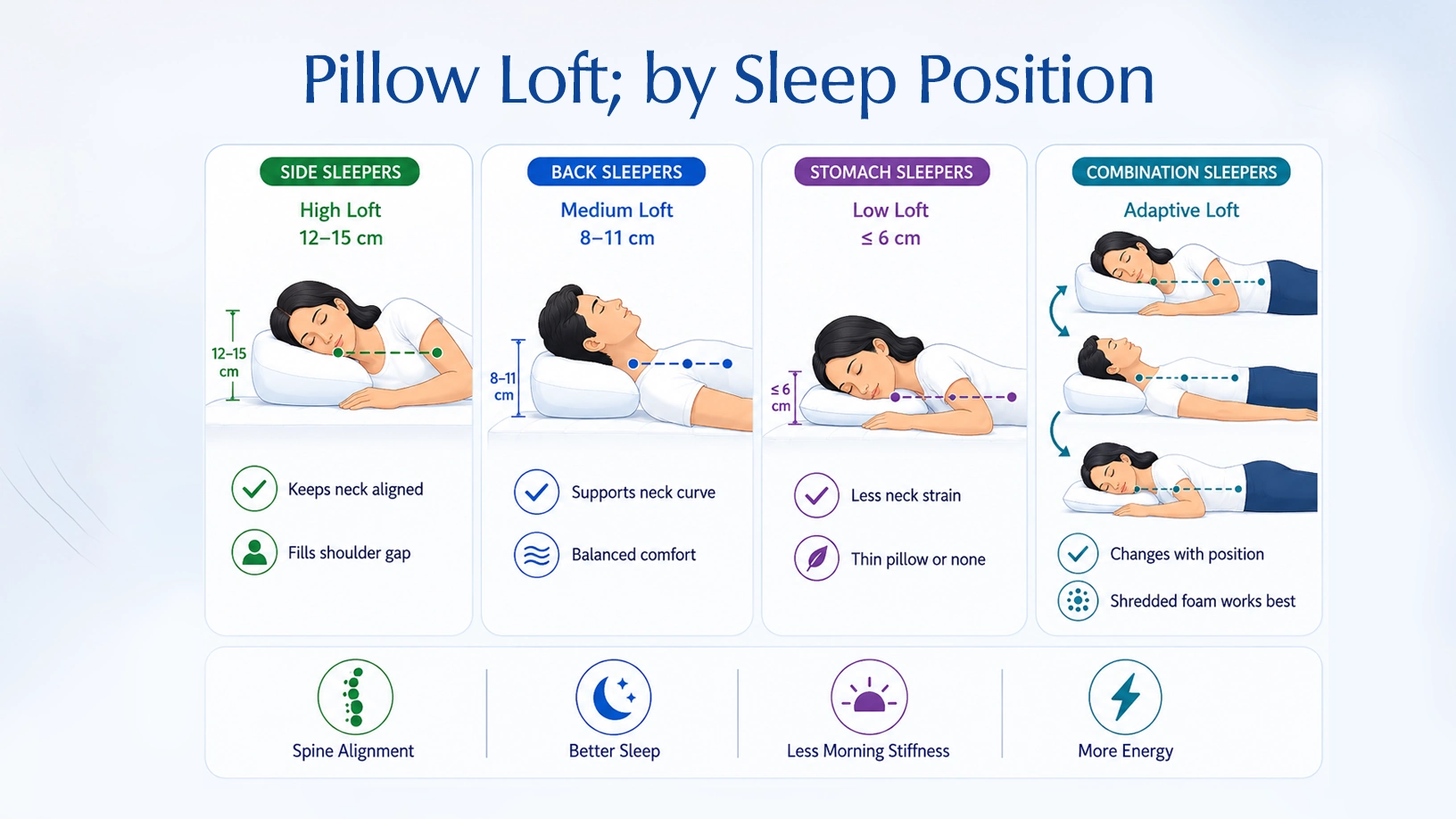
Side sleepers — high loft (12–15 cm)
Your shoulder creates a gap between your head and the mattress that the pillow needs to fill. The bigger your shoulder, the higher the pillow. Goal: keep the head, neck and spine in a straight horizontal line. A small visual test: if a friend takes a side-on photo, your head should be at the same height as the shoulder, not tilting up or down.
Back sleepers — medium loft (8–11 cm)
You need just enough lift to fill the small natural gap behind the neck. A pillow with a slight rise at the bottom edge (cervical contour) works well. Avoid stacking two pillows — it pushes the chin toward the chest and strains the cervical muscles.
Stomach sleepers — low loft or no pillow (≤6 cm)
This position already strains the neck (the head is rotated 90°). A high pillow makes it worse. Pick a very thin, soft pillow or sleep without one. Some stomach sleepers do better with a flat pillow under the hips and none under the head.
Combination sleepers
If you switch positions through the night, pick a pillow that compresses naturally to the right loft for each position. Shredded memory foam and microfibre pillows do this better than solid block memory foam.
Pillow fills — the personality

- Microfibre / hollow-fibre: cloud-like, soft, easy to wash, affordable. Compresses too much over 1–2 years and needs replacing. Good for back sleepers and combination sleepers.
- Solid memory foam: holds its shape all night, contours to the neck. Best for side sleepers with neck or shoulder issues. Sleeps slightly warm in summer.
- Shredded memory foam: combines memory foam contouring with the adjustability of a soft pillow. Excellent for combination sleepers. Premium fill.
- Latex: bouncy, breathable, durable for 5+ years. Heavier than microfibre. Good for hot sleepers.
- Down / down-alternative: very soft, compresses too much for most side sleepers. Works for stomach sleepers and back sleepers who like a soft head feel.
The simple "wrong pillow" test
- Lie down in your usual sleep position.
- Have someone photograph you from the side.
- Look at the photo: your ear should be roughly above your shoulder, with the neck in a smooth horizontal line.
If the ear is forward of the shoulder, the pillow is too high. If it is behind the shoulder, too low. If the photo looks fine but you still wake stiff, the issue is the fill, not the loft — consider switching from microfibre to memory foam, or vice versa.
How often should you replace a pillow?
- Microfibre / hollow-fibre: every 1–2 years.
- Memory foam (solid or shredded): every 2–4 years.
- Latex: every 4–6 years.
- Down: every 4–8 years (with regular fluffing).
The "fold test" tells you when: fold the pillow in half and let go. A fresh pillow springs back open immediately. A pillow past its prime stays folded or recovers slowly.
Special cases
- Snoring or sleep apnoea: a slightly higher pillow opens the upper airway. Talk to a doctor first if symptoms are persistent.
- Acid reflux: a wedge pillow or a slightly elevated head end of the bed helps far more than a thicker regular pillow.
- Pregnancy (later trimesters): a side-sleeper pillow plus a body pillow (or a pillow between the knees) keeps the spine and pelvis aligned.
If your pillow is more than three years old and looks flat when folded in half, you have already found the cause of your stiff neck.
Pillows by Sparsh
Our MEMO Sleep Pillow uses contour memory foam designed for side and back sleepers. The Fleecy Pillow is a softer microfibre option for back and combination sleepers.
See Pillows